Sunday, 22 January 2017

Bombo Beach, Kiama

The New South Wales Illawarra coast south of Sydney gets scant attention for its loveliness. It has some of the most spectacular scenery and beaches in this part of Australia and its climate is not dissimilar to Sydney however with the exceptions of Jervis Bay and the bus tourists who stop off at the Kiama Blowhole, foreign travellers tend to miss it out and head to Port Stephens, Coffs Harbour and up the east coast.

This is very much a pity - a travesty even. The beaches and coastline in the area are breathtaking and can be done cheaply in a day or overnight using Sydney Trains and paying no more than several dollars. While there are few if any backpacker hostels you can book a single room in some of the pubs for no more than $40-$70 per night. Busy tourist towns like Kiama and cities like Wollongong offer opportunities for hospitality work that you won't be competing with other travellers for.
Apart from the above, I write about the Illawarra and Shoalhaven because I am in love with these places - their beauty and history, the friendliness of the people, the busy cafes and pubs, the world class beaches and the ease of access. However there is so much I should write that I would not give the area justice by not concentrating on my favourite parts of it one at the time, so let me start off with Bombo....

Bombo, next to Kiama and about 2.5 hours by train from Sydney, is one of only two NSW beaches with its own railway station (The other being Coffs Harbour). It is a quiet suburb with large and stunning surfing beach. The one remarkable thing is that despite its beauty and proximity and ease of access to towns such as Kiama, Shellharbour and Wollongong, it is usually very quiet. About as quiet as you can get. It has light sands, clear waters and views of Kiama's headland, but no shops and a small car park. Perfect for sunbathing and picnics.


View of Bombo from the Kiama headland.


The walk from Bombo to Kiama involves passing alongside a quiet creek underneath the railway bridge and walking up a steep hill where the sweeping Bondi-esque curve of the beach reveals itself in picturesque manner. The walk down the hill towards the tourist town of Kiama continues past little bijoux, clothes and book shops along with quirky, vegetarian-friendly cafes. On weekends there is also a large outdoor market that is well worth a visit.

Is it worth visiting Bombo beach on its own from Sydney? Probably not, however it is worth considering it as part of a larger tour of discovery of the Illawarra. There is a lot to be said about the pretty seaside town next door, Kiama, however that should be left for its own blog. Enjoy!

Returning to Blogging

Dear All, after a few years of not doing any writing I have decided to return to regular blogging. Sydney is still an amazing city which I love and yet some of its best treasures are still hidden from the eyes of most backpackers and tourists.

Much has happened in the past few years. I became a permanent resident, now able to apply for citizenship, and married my wonderful wife, who herself grew up in Western Sydney. We moved to Lidcombe at the extreme end of the inner west, notable for its great Korean immigrant community and its many eclectic Korean-run coffee shops. We are currently on the lookout for a new house in Bankstown, a suburb south of Lidcombe famous for its Vietnamese and Lebanese cultural heritage and one of the greatest and most eccentric entertainment complexes in Sydney, Bankstown Sports.

I look forward to posting content about this great city that I hope you all enjoy. I would also like your feedback and comments. Watch this space! :-)

Wednesday, 17 September 2014

Woy Woy and the Brisbane Water National Park, Central Coast

Last Sunday (14th Sept 2014) I took a meetup group up to the Central Coast, a stunning national park area about an hour and ten minutes north of Sydney. We visited the town of Woy Woy, surrounded by stunning hills, lakes and mangroves and very accessible by train from Sydney.

Woy Woy itself is situated in the heart of the Brisbane Water National Park, and close to beautiful beaches such as Umina and Ettalong, accessible on the Newcastle and North Coast rail line for a cheap price. Its main street contains some hippie Byron Bay-esque shops and cafes. It is a tourist area although the vast number of tourists are those from Sydney and Newcastle on day or weekend trips.

The real key to visiting Woy Woy is the beautiful scenery and wildlife, particularly the cockatoos, lorikeets and large Australian pelicans who will swoop for your chips if you aren't careful! There are numerour hotels and guesthouses in the area, although no backpacker hostels I am aware of.

The Riveride walk starts just east of the Railway Station and is beautiful enough not to need comment, therefore I have just posted pictures below. Following the walk will take the rambler as far as Ettalong and Umina beach, although we did not go so far on our trip.

Like the rest of the Central Coast, this area is well worth a visit for its beauty alone, however it provides a great day out for bushwalking and watersports and is definitely worth checking..


Sunday, 30 March 2014

Cabramatta - Slices of Southeast Asia 1 hour from Sydney

Dear All,

Apologies for the lack of blog posts. I have had other commitments on my time recently, however and fully committed to regular blog posts on content you would find interesting,

Cabramatta, a suburb in the South West of Sydney about 1 hour from the CBD by train. Due to its mix of Vietnamese, Lao, Cambodian, Macedonian, Thai and Chinese populations, it is famous as a unique cultural melting pot with great restaurants, cheap markets and a unique atmosphere. It is an old suburb by Australian standards, dating from the first village of 1814 to take the name and a township arising in the 1850s,  however the creation of the Cabramatta and Villawood Migrant Hostels in the 1970s and 1980s were, along with the increase of immigration of refugees from the Vietnam War (a policy of the Whitlam Government - Gough Whitlam himself lived for a time in Cabramatta), instrumental in the place developing a large South East Asian population that defines Cabramatta's unique multicultural character today. It is now Australia's largest non-anglo-celtic town centre and considered a culinary centre for south South East Asian cuisine.

Its unique shops, restauramts, architecture, signage, peoples and atmosphere have created an ambiance that would not be out of place even in Saigon. It is worth the 1h trip. Also the prices of food, clothes and other items in its markets are often much cheaper than the equivalent in the Sydney CBD or the Eastern Suburbs.

Here are some pictures of my most trip today below...

Freedom Plaza by Park Road, with the Pagoda at the far end.


Belvedere Arcade, often called "Vegan Alley" due to the large number of Buddhist vegan restaurants in and around it. The arcade does however contain several restaurants serving meat...


Pho 54 Vietnamese Restuarant on Freedom Plaza

One of the many shopping and market areas.


The Loving Hut Vegetarian Restaurant on Cabramatta Road West, one of the most well known restaurants in Cabramatta and part of an international chain of restaurants formed and owned by Vientamese-American Buddhist leader Supreme Master Ching Hai
Yum! :D
There is a wide range of well-priced South East Asian (meat and vegetarian) restaurants in the suburb along with great shops and markets. Well worth a visit and exploration if you need a change of scenary outside of the CBD and tourist areas....

Tuesday, 11 February 2014

Balmain by Boat


Instead of my usual train from North Sydney to my home in the Inner West I decided to take the ferry to Balmain and bus it from there. The reason I did this is that any opportunity to enjoy Sydney Harbour by boat and to more explore a historic suburb I find interesting and beautiful is always a welcome one.


Despite the dull and overcast weather, the view of the Harbour Bridge and the Opera House from Milson's Point Ferry Wharf is always breathtaking, along with pleasant views of Lavendar Bay and Walsh Bay across the harbour. The public ferries are a cheap and convenient way to see the sort of "Million Dollar Views" that usually adorn postcards, as anyone who has taken the Sydney-Manly ferry service can attest to.

The view from Milson's Point Ferry Wharf
The short trip to Balmain Ferry Wharf takes in impressive views of the Harbour Bridge, the skyline of the Sydney Central Business District and Goat Island. I arrived at Balmain at Mort Bay and saw a number of cheerful sights in the adjecent park - groups of people doing exercise drills, children playing and riding bicycles and older people fishing from the edge of the wharf.

Fishing at Mort Bay

Named after colonial surgeon Dr. William Balmain who was granted the land by Governer John Hunter in 1800, industrial and residential development and settlement started in the 1830s and 1840s and soon Balmain became a prominent industrial area for the working class of Sydney. Since the 1960s, industry has waned in Balmain to be replaced by increasing industrial gentrification - Sydney's middle class attracted by Balmain's beauty and proximity to the city. Many of the old factories have been replaced by low-rise residential developments. Former Prime Minister Paul Keating once described the burgeoning middle class of the suburb as the "Basket Weavers of Balmain".

Heading up the hill to Balmain's high street are streets of attractive Victorian and Federation-era houses of different styles. Also of note were two colonial-era pubs I passed, the Dry Dock Hotel (Balmain's oldest licensed pub, dating from 1857, and with charming decor) and the Free-Classical style Royal Oak Hotel (opened in 1878, and important in the history of the Australian Union Movement).

Dry Dock Hotel, 22 Cameron Street

Royal Oak Hotel, 36 College Street
I had the impression that these pubs, inevitably due to their ages, have a cosy British Pub-type feel, along with a good range of beers and provision of food that would make them worthwhile drink stops in any traveller's discovery of Balmain.

Darling Street, the main street of Balmain, has a plethora of interesting bijoux clothes, health and beauty shops, pubs and restaurants fairly close together. Even on a Tuesday night, bars such as Cantina Bar and the Cottage seemed busy and vibrant with a young crowd and decent music.


The Cottage Bar and Kitchen
Cantina Bar


Other notable places on Darling Street are Monkey Bar and the beautifully restored 140+ year-old London Hotel, from which one can avail of the restaurant, observe the Harbour Bridge from its balcony and enjoy its boutique beers and ciders. The beautiful Gladstone Park, sitting above the historic Balmain reservoir, provides areas for outdoor relaxing and contemplation.


Gladstone Park
London Hotel, 234 Darling Street
As far as interesting and entertaining inner suburbs go, Balmain has much to offer the inquisitive traveller, and rarely disappoints.


Sunday, 9 February 2014

Rock & Roll Alternative Market - For the Rockabillies, Mods, Rockers and Aspiring 50s Pin Ups and Burlesques among us

Following on from the Sydney University post, yesterday my (wonderful) girlfriend and I visited an interesting and eclectic alternative market and music festival held at the University's Manning Building every 2 months.

While being slightly weighted towards retro pinup fashions, the market sells anything and everything a person in the retro 50s and 60s subcultures would want (and a good day out for everyone else), staffed often by stylishly quiffed 50s Rockabilly guys and glamorous-looking, big-hair and red lipsticked pin up gals. Stalls stocking clothes, jewelry, bags, cult videos, posters and room decor and books, along with good food abound over three floors.

(My photos)...


On the second floor I saw a retro hairdressers and makeup stylist section.

Upstairs I saw a few 50s rock bands playing what appeared to be throughout the day in the Manning Bar to a packed crowd dancing and drinking. Lots of fun...

If you are keen on visiting, feel free to visit the website and facebook group for more info and a flavour of the event.

The University of Sydney

One place that I enjoy visiting for its beautiful Victorian sandstone architecture, interesting and free museums, serene environment and well-tended parks, lawns and cloisters is the Camperdown/Darlington campus of the University of Sydney. I recommend it for any traveller looking to get away from the bustle and high-rises of the CBD and interested in some of the most beautiful architecture and best museums Sydney has to offer.

The University of Sydney, the oldest and among the most prestigious of Australian Universities, dates from 1850 and has been at its present site in Camperdown since 1859. It is seen as a continuation of the traditions of the great Northern Hemispheric universities in the Southern Hemisphere, with its motto "Sidere mens eadem mutato" loosely translated as "The constellation is changed, the disposition is the same."

In terms of beauty and architecture it takes its inspiration from the ancient universities of Oxford and Cambridge (with which it shares some aspects of the collegiate structure). It's most famous building, the Neo-Gothic Main Quadrangle, dates from 1854 and is stunning to walk around. Here are some photos from two recent trips I made.


The exterior of the Main Quadrangle


The Great Hall  


The Main Quadrangle also contains the Nicholson Museum and University Art Gallery. The Nicholson Museum, open and free to visit Mon-Fri and on the first Saturday of each month, has the largest collection of Greek, Italian, Egyptian, Cypriot and Near Eastern antiquities in the Southern Hemisphere. It is definitely worth a visit. The Macleay Museum, which hosts the scientific and matural history collections of the University, is also free and nearby.

The University Main Quadrangle is fronted by a great staircase leading to the sculpted lawns, lakes and outdoor pool of Victoria Park, on Broadway only about 15 minutes walk from Central Station. It is a great area to chill and relax and also hosts various events throughout the year.

Victoria Park looking towards the University Main Quadrangle
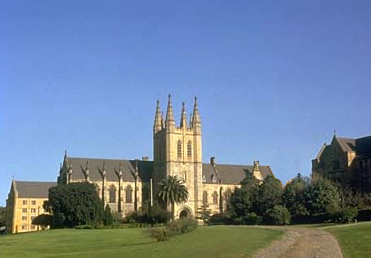
The colleges themselves, slightly away from the Main Quadrangle and not open for the public to walk in, are impressive and reminiscent of Oxbridge colleges. I have taken photos of two, St. John's College and Sancta Sophia College, although a total of six residential colleges exist.
The entrance to St John's College, established in 1858


St. John's College (Courtesy of Wikipedia)


Sancta Sophia College, which dates from 1925


The University of Sydney, assuming you have time in your trip and the inclination to do so, is well worth a visit for its free exhibits and its architecture, and only minutes walk from the CBD. Definitely a beautiful and enjoyable addition to Sydney's delights.